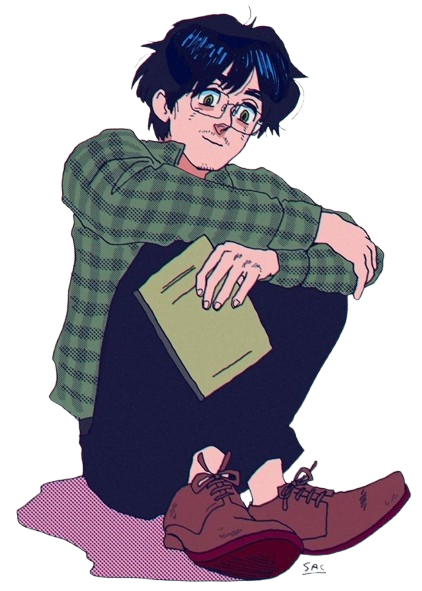
Issue 4: The Nature of Analog
Smiling Friends, the Radio, and Media
Letter From the Editor
Dearest Reader,
One thing I’ve never understood about the world is how we can look at all of the possibilities and think that it’s a great idea to stuff ourselves into one particular box. I love drawing, coding, filming, writing, calculating, analyzing, managing, cooking, reading, joking and yet I have to choose only one to devote the rest of my life to?
When I told my parents I was going to get a degree in Interdisciplinary Studies, they looked at me like I was insane. What kind of a career could be built upon a degree in multiple things? Recently I went on-demand at a job I had for seven months because, frankly, I was bored. The longest I’ve held a job is a couple of years without feeling trapped, and I work minimal hours at it. I’ve been told to grow up and choose more times than I can count, but I feel completely paralyzed when I have to make that decision.
I’ve tried going over the possibilities in my head over and over again to make the best decision, and yet I can’t. I sit in my chair, writing this, because I’m trying to convince myself that I’m making progress. But, suffice to say, I am not making any progress and I will not until I commit to one option or another. Perhaps now that the grass is green again (I think… I live in Arizona so it doesn’t really work like that for me) it’s time to get outdoors and think about nature and ourselves.
In this issue, we’re going to discuss the ending of Smiling Friends and the promotion of original works within the animation industry, being “analog” for free by listening to the radio, and some media that reminds me of the outdoors or getting out of your comfort zone.
Overanalyzing Fiction
March’s analysis is of the Ending of Smiling Friends.
Adult Swim recently announced that the popular adult animated show Smiling Friends would be prematurely ending after just three seasons. I, like many others, adored Smiling Friends. I thought it was the perfect example of what adult animation could become, especially in a world conquered by the common vulgarity of adult animation. I thought the third season was a triumph from the moment we got to see the entirety of Silly Samuel at the Smiling Friends SDCC panel. It’s rough to know that your favorite show is ending, especially one that seems so effortlessly original and unique. However, I think that the decision to end Smiling Friends before its time will have positive effects on the animation industry as a whole.
Right now, the animation industry thrives on the idea of milking old concepts as long as it takes. Reboots, remakes, and reusing creators are what the public is watching, and animation studios ruled by corporate overlords are moving less towards taking chances on newer creators and more towards this reliability that reusing IP has. While shows from Adult Swim like Rick and Morty are approaching Season 9 and other comedic animated shows geared towards adults like South Park just finishing up Season 28, shows like Smiling Friends disrupted the norm. And here we are, February 26th 2026 when Smiling Friends has disrupted the norm again: quit in the face of success. What makes Smiling Friends so amazing is its simple concept (make someone smile every episode) and funny cast of characters. With a formula like that, I thought Smiling Friends would be right up with Rick and Morty at nine seasons. And yet it has stopped after 3. But how does the ending of a fantastic original show result in any positive effects for the animation industry? Wouldn’t it just mean that industry giants like Adult Swim can’t trust smaller creators (smaller used rather lightly here to describe two Newgrounds powerhouses) to pitch shows?
Firstly, the ending of Smiling Friends happening the way that it did means the power of TV shows is back in the hands of creators. Hadel and Cusack chose to end their show, a mercy that is not common within the animation industry anymore. There are so many shows like Infinity Train and the Owl House that were cancelled by networks and, in the case of Infinity Train, wiped off of streaming. Therefore the fact that Hadel and Cusack were even able to have that much control over the future of their show is a miracle in and of itself. Hopefully networks begin to take notes about the importance of creator-input and start valuing their creators’ opinions of their shows and their stories.
Secondly, the reason why Smiling Friends ended was to preserve the quality of the show, something that networks have cared little about. They just care if enough people will watch another season of Rick and Morty, not about the integrity of the story and its characters. Two great examples of this self-inflicted ending of a show are Gravity Falls and Avatar: The Last Airbender. Imagine if after a full summer spent with Dipper and Mabel there was another season. What would the mystery be? Would it be as succinct as the first two seasons? Even worse, imagine after Sozin’s Comet we had another season of Avatar: The Last Airbender. What would even be happening? Those two examples were of shows that follow a full storyline that wraps up perfectly at the ending. How about Smiling Friends and its episodic format? Rick and Morty started in 2013. It was the first animated show I ever saw that was geared towards adults and it took pop culture by storm. Pickle Rick, one of the most memorable episodes, came out in its third season. Rick and Morty has an episodic format; most of its episodes are standalone and not a part of a full storyline. As of 2026 (THIRTEEN YEARS LATER) and the removal of one of its co-creators, it is still going strong. However, because of this episodic format, Rick and Morty does not know when or where to end. It has a similar format to Smiling Friends: each episode has to have an adventure. When there is a simple formula, creators can spend a multitude of seasons beating a dead horse and attempting to revolutionize this formula to no avail. This results in a show that was once lauded endlessly for its reconstruction of the adult animation format, but is now a mere shell of its former self. By ending Smiling Friends, Hadel and Cusack forbid their show from becoming what Rick and Morty has: a show that is constantly trying and failing to replicate the success that it did back in the glory days.
(I would like to say that I still watch Rick and Morty out of curiosity when new seasons do come out and I enjoy some of the episodes. That said, nothing has come close to its first three seasons for me.)
Smiling Friends being cancelled makes me super sad because I thought we were at the peak. I will constantly say that Mole Man is a perfect episode of television and one of the most perfect episodes of adult animation I have ever seen. Scenes like the one with Mr. Frog and his father have become relatable to the audience, and Silly Samuel was one of the greatest introductions to a season of Smiling Friends we have seen yet. That all to say, we (and networks) need to trust the creators of these shows, and I think that the decision to cancel Smiling Friends will help the animation industry as a whole. There are so many reasons why a show as successful as Smiling Friends would be cancelled in this way, and we need to trust that Hadel and Cusack know their show and are making the right decision. That being said, the animation industry really needs a win right now, especially under these large corporations that disregard the power that animation has. Hopefully the cancellation of Smiling Friends causes them to take some notice about the importance of creator input and the importance of episode quality over quantity.
So rest in peace Smiling Friends… you were everything to me, but hopefully your sacrifice will signal a much larger chance within animation.
Challenges
This month’s challenge is to replace Spotify with the Radio.
For context, I’ve had music services for as long as they’ve been a thing. As soon as my iPod died, I had Amazon Music, and now I’m fortunate enough to piggyback off of a family Spotify Premium account. So why throw it all away? I wish I could tell you, dear reader, but my mind is a steel trap. I get bored easily with my music. I have three playlists: the current season, work, and a compendium of any song ever added to a playlist. Every week I would listen to my Discover Weekly religiously to find new music, but I never feel satiated by the algorithm. Something is always… off. I can’t find the vibe I want, or I don’t want to be recommended “edgy, emocore, skinny jeans, mallgoth, black nail polish, post-hardcore.” Maybe I don’t want a “dreamgaze dream pop Monday afternoon!”
The first thing I did when I started this project was preset all of the important stations on my car. She has mostly pop/alt stations, with the occasional classical station and the jazz station that warps in and out of static every so often. I grew up listening to the radio, and most of the stations in my state have catchy jingles that I remembered to specifically mark as favorites. My first few days listening to the radio were boring. I kept wanting to hook up my Apple Carplay and was trying to prove that I still had an attention span by sitting through advertisements instead of changing the channel. I did this for about a week, mainly listening to shitty pop music. I itched for Magdalena Bay’s “Cry for Me” and Paramore’s “Caught in the Middle,” but I stuck to my guns.
About two weeks into my little experiment was Halloween night, which I was driving a lot during. As I was changing in my car after work, I turned on the radio and went to the classical music station where they were playing the instrumental scores of various horror movies. There is nothing like driving a curvy road in the middle of nowhere with the Cape Fear soundtrack playing in your car. Later that night, I picked up my friend and sheepishly apologized about the classical station playing. She just laughed and said that she’s actually been missing classical music. This moment was kind of a turning point for me, because I realized how personal radio seemed. I started to notice the little quips of the host for the hour in between songs, the personal stories interlaced between shitty pop music. I recognized that most of the advertisements were for local companies or events still held by the station, despite the rise of music streaming that undoubtedly obliterated their amount of listeners. I thought about my grandparents who used to always have the radio playing at their house on a low volume, and imagined the excitement of when the radio first came out. I got excited when my jazz station would finally come in, and got even more excited when a song I recognized came on the radio.
The radio is going obsolete, there is no doubt about it. More people are going to music streaming services than ever before, and less people are tuning in. The most important thing I learned from this experiment (other than that I might never need Spotify again) is that the radio brings me lots of joy. This is one experiment that I would do again, ten times over. So adjust your channels, tune in, and give it a try.